
Your LinkedIn Headline Is a Credibility Gate. Most AEs Fail It.
In enterprise sales, your LinkedIn headline determines whether a buyer responds to your outreach.
It is not a job title.
It is not an HR summary.
It is the first filter a prospect applies when deciding whether you are worth engaging.
When a prospect checks your profile, the evaluation happens in seconds.
“Is this person credible enough to engage at our level?”
If the answer is unclear, the opportunity never forms.
No objection.
No competitive pressure.
No pricing discussion.
The buyer simply doesn’t respond.
In high-consideration B2B sales, many deals never start because the seller wasn’t perceived as credible enough to engage.
Most sellers never realize they failed this early evaluation.
What Actually Happens When a Prospect Checks Your Profile
A prospect receives your outreach.
They click your profile.
They scan your headline.
In seconds, they decide:
“Is this AE worth engaging?”
If the answer is unclear, the opportunity never forms.
There is no objection.
No competitive battle.
No pricing pressure.
Just silence.
In high-consideration B2B sales, silence is often a lost deal.
Most sellers never realize they failed this early gate.
Why a Title-Only Headline Undermines You
Most LinkedIn headlines look like this:
Senior Account Executive | Company Name
Enterprise AE | SaaS | President’s Club
Sales Professional | 10+ Years Experience | Revenue Growth
This language communicates one thing:
I sell.
It does not communicate:
I understand your industry
I’ve seen your problem before
I have judgment in your category
Buyers evaluate the seller before they evaluate the solution.
If your headline doesn’t signal relevance, you are categorized as “another salesperson” before you ever speak.
And categorization drives engagement.
When a Job Title Is Actually Enough
There is a narrow exception.
If you work at a company with overwhelming inbound demand and most of your pipeline comes from brand momentum, a title-only headline may not hurt you. (1% of sellers)
But for most enterprise AEs, especially those sourcing pipeline or competing in crowded categories, your headline must do more.
Strong brands reduce friction.
They do not replace sales-rep credibility.
The Real Job of Your Headline
Your headline has one purpose:
Make a serious prospect want to learn more about you.
It should communicate two things clearly:
Who you help
What problem you are credible to solve
That’s it.
Not quota attainment.
Not awards.
Not generic sales skills.
Buyers do not care how effective you are at selling.
They care whether you understand problems like theirs.
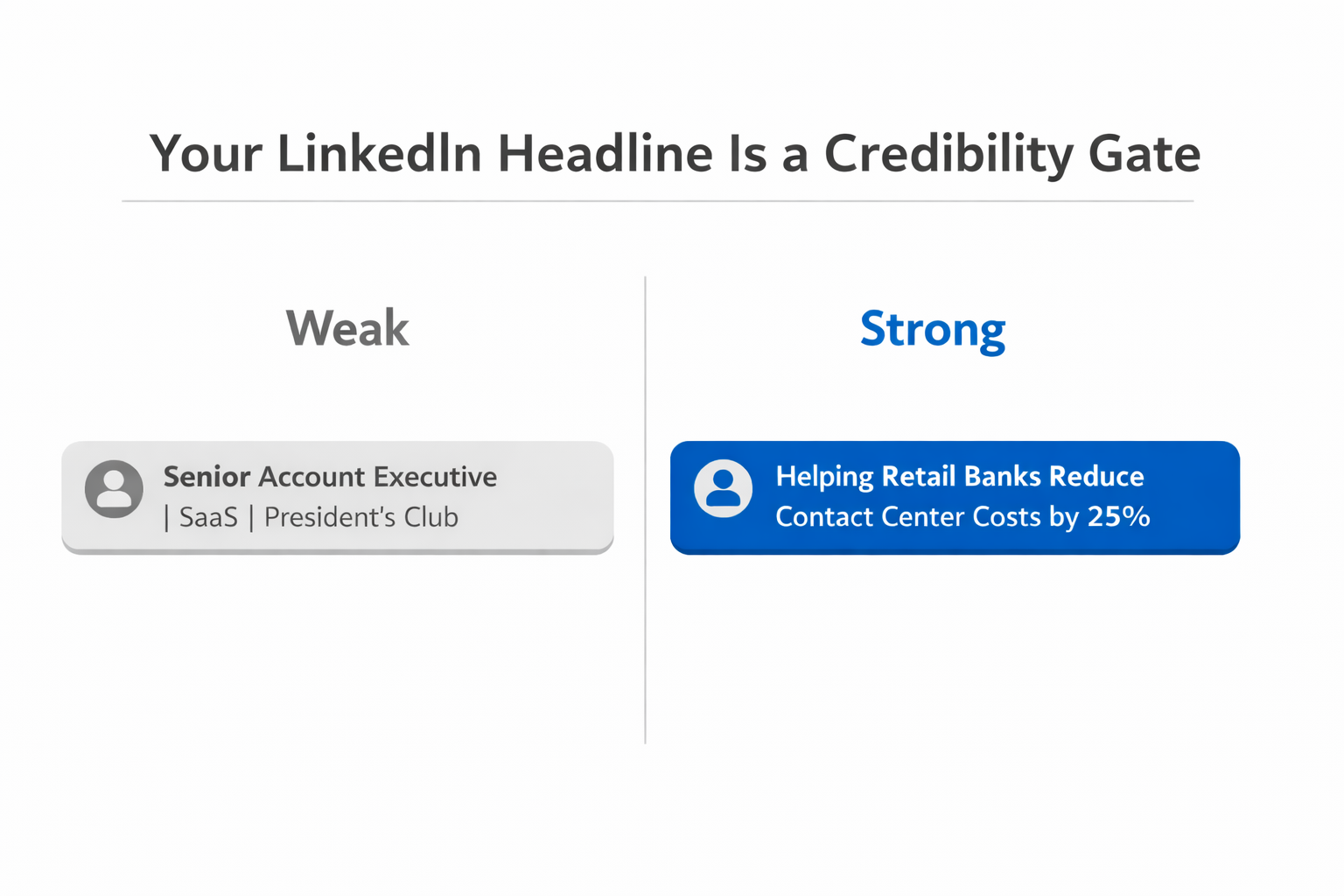
Strong vs. Weak Examples
Weak:
Senior Account Executive | SaaS | President’s Club
Stronger:
Helping retail banks reduce contact center costs by 25%
—
Weak:
Sales Professional | Lead Generation | CRM | Cross-Selling
Stronger:
Working with mid-market fintech firms navigating compliance-driven CX transformation
The difference is simple:
One describes the seller.
The other describes the buyer’s world.
When buyers recognize their world in your headline, they are more likely to respond.
Why This Matters in High-Consideration Sales
In complex technology sales, buyers are filtering constantly.
They are asking themselves:
Is this person credible enough to engage at our level?
Will this interaction be useful or transactional?
Is responding worth my time and cognitive load?
That evaluation happens before a conversation.
If your headline fails to establish relevance, the buyer may never progress to evaluating your product.
And you will never know the opportunity existed.
A Practical Test
Read your headline and ask:
If a prospect saw only this line, would they immediately understand why I might be useful to them?
If the answer is no, your positioning is leaking credibility.
Your LinkedIn headline is not about employment status.
It is about perception.
And perception determines whether a buyer responds.
If you’re an experienced AE and buyers are going quiet after reviewing your profile, the issue may not be outreach volume.
It may be how you’re being positioned at the moment of evaluation.
Sales Identity Studio exists to address that specific moment - the decision that determines whether a buyer responds at all.
